Short answer
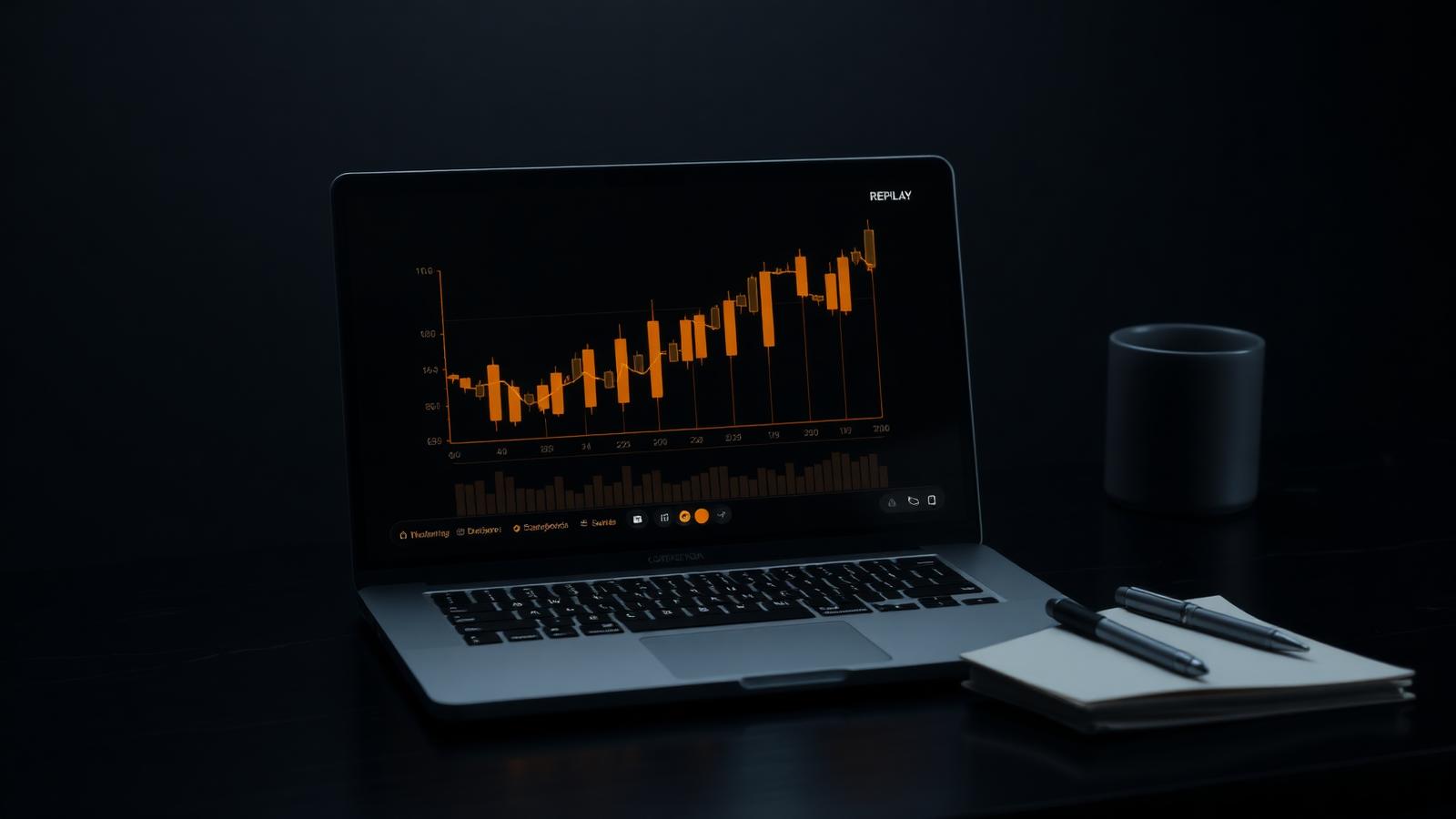
A price action backtesting tool replays historical price bar-by-bar so you place trades without seeing the future. For prop firm preparation it also needs realistic futures data, drawdown-aware journaling, and per-session statistics — not just an equity curve from an automated strategy.
Manual replay vs automated backtesting
Automated backtesting answers "would this code have made money?". Manual replay answers "would I have made money?". Discretionary price-action traders need the second one, because their edge lives in decisions a script cannot encode: which sweep looked clean, whether the displacement was convincing, when to skip a session entirely.
That is why the correct tool for a price-action trader is a bar-by-bar replay simulator with order entry, not a strategy tester.
What a serious backtesting tool must have
- — True bar-by-bar playback with no way to peek at the next candle.
- — 1-minute or finer historical data spanning years, not months.
- — Real order types — market, limit, stop, multiple take-profits, and draggable stops.
- — Automatic journaling that records entry, stop, target and R multiple per trade.
- — Session and killzone context drawn on the chart so results can be filtered by time window.
- — Drawing tools that persist while you step forward, so your marked levels stay put.
- — Statistics that matter for evaluations: win rate, expectancy, max consecutive losses, and worst peak-to-trough drawdown.
What prop firm backtesting software needs on top
A funded evaluation is not a profit contest, it is a drawdown-survival contest. Software aimed at prop firm candidates has to make the constraint visible while you practise.
| Constraint | Why it changes your backtest |
|---|---|
| Max daily loss | A model with rare large losing days fails even with positive expectancy |
| Max total drawdown | Sequence of losses matters as much as the average |
| Profit target | Determines the minimum R per session you must average |
| Consistency rules | One outsized winning day can invalidate a pass at some firms |
| Contract limits | Caps position size, so expectancy per contract has to be enough |
Practically, that means backtesting in blocks the size of an evaluation — say 20 consecutive sessions with your actual risk per trade — and asking not "was I profitable?" but "did I ever breach the daily loss limit?".
The main options in 2026
| Tool | Data | Bar-by-bar | Install | Notes |
|---|---|---|---|---|
| NQ Replay | Years of 1-minute NQ / MNQ | Yes | None — browser | ICT overlays, killzones, journal, free plan + Pro from $12.99 |
| TradingView bar replay | Broad markets | Yes | None — browser | Limited order simulation on lower tiers |
| NinjaTrader Market Replay | Futures, tick-level | Yes | Windows desktop | Powerful, heavier setup and data management |
| FX Replay | FX-focused, broker data | Yes | None — browser | Strong for FX, subscription-first |
| Custom scripts | Whatever you source | No | Local dev setup | Automation only; cannot test discretion |
Pick on the basis of the market you trade and whether you need decision practice or code validation. There is no single best tool — there is a best tool for a Nasdaq price-action trader preparing for an evaluation, and that is what this site was built to be.
How to run an evaluation-grade backtest
- — Write the model in one paragraph: bias, trigger, entry, stop, targets, session filter.
- — Choose 20 consecutive historical sessions — no cherry-picking.
- — Set risk per trade to the same fraction you would use funded, typically 0.5%.
- — Replay each session from the open, one bar at a time, and commit before revealing the next candle.
- — Log every trade, including the ones you skipped and why.
- — Read the drawdown before the profit. If a simulated daily loss limit was breached, the model fails regardless of the total.
An evaluation is passed in backtest three months before it is passed live.
Start on the free plan
The replay trainer here runs in the browser with historical Nasdaq futures data, draws killzones and fair value gaps automatically, accepts real order types, and writes every fill to a journal that computes expectancy and drawdown. The free plan is enough to build a first 50-trade sample: six months of sessions and 20 orders a day (each buy or sell counts as one), with the full 10+ year archive on Pro from $12.99/month.